
Introduction Longevity In terms of longevity, the only rival it has is India’s, the other civilization that dates back to ancient times which is still flourishing today. And indeed, the Indus civilization pre-dated the rise of literate, urban civilization in China by about a thousand years. However, it later vanished, and cultures in the Indian […]
Chinese history
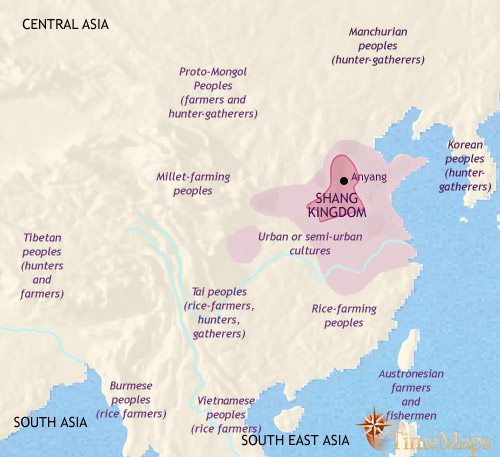
Ancient China: Civilization
<< back to history atlas: Maps of China
Overview of the history and civilization of Ancient China
Philosophy, Religion and Culture in Medieval China
Philosophy The Late Han period and after Confucianism Confucianism had been the official ideology of the Han dynasty, and it retained this status in all the Chinese states which succeeded the Han. It remained the focus of the officials’ educational curriculum and continued to shape the outlook of the elite. However, in the troubles which […]
Society and Economy in Medieval China
Section 1: The end of the Han empire and the period of division A census in 140 CE showed that the Han empire (201 BCE to 220 CE) had a population of some 50 million people. This was down from nearly 60 million at the beginning of the 1st century CE. The large-scale wars and […]
Government and Warfare in Medieval China
Section 1: Bureaucracy The centuries between the end of the Han dynasty in 220 AD and the founding of the Sui dynasty in 589 AD saw China weak, divided, invaded and partially occupied by tribal peoples from beyond its borders. Nevertheless, throughout these chaotic and violent times, the tradition which four centuries of stable Han […]
Medieval China
Historical overview of Medieval China After the fall of the Han empire, the first great empire in Chinese history (202 BCE to 220 CE), China experienced more than 350 years of disunity (220 to 589 CE). Division and reunification In northern China, these centuries were characterized by barbarian invasions and other upheavals, followed by the […]
The Sui Dynasty of China
The reunification of China After the fall of the Han empire, the first great empire in Chinese history (202 BCE to 220 CE), China had experienced more than 350 years of disunity. In northern China, these centuries had been characterized by barbarian invasions and other upheavals, followed by the establishment of various kingdoms ruled by […]
The Qin Dynasty of Ancient China
The Qin dynasty of Ancient China was the first dynasty in Chinese history to bring unity to the vast country, but its harsh rule brought about an early downfall.
Tang Dynasty China
Historical outline of the Tang dynasty The Foundation of the Tang dynasty China had been reunited by the Sui dynasty in 589 CE, after centuries of division. However, the second emperor of the Sui dynasty, emperor Yang, seems to have been a megalomaniac. His grandiose schemes caused misery for millions of peasants forced to labor […]
Song Dynasty China
An outline history of the Song dynasty The Song dynasty is divided into two halves. The “Northern Song” dynasty (969-1127) ruled most of China; the “Southern Song” dynasty (1127-1279) ruled only southern China. The rise of the Song In 960 China had been divided amongst numerous different states for more than fifty years, ever since […]
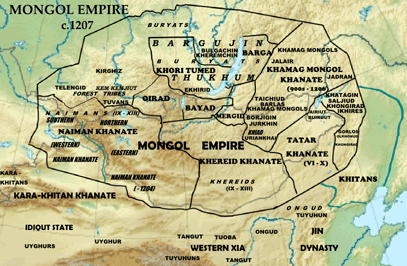
The Mongol Empire
The Mongol Empire was not a civilization in the strict sense of the word, but by being the largest land empire in world history it had a huge impact on the Chinese, Islamic and European civilizations.
The Zhou Dynasty of Ancient China
<< back to the World History Atlas: Maps of Ancient China
The Zhou dynasty, the longest-lasting dynasty in Chinese history, endured from 1122 BCE to 256 BCE, and saw ancient China dramatically transformed
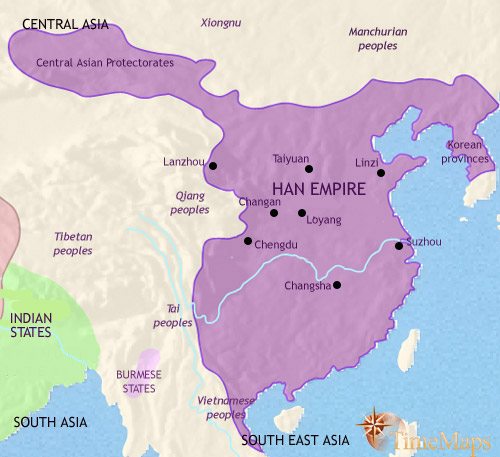
The Han Dynasty of Ancient China
The Han dynasty, one of the most important dynasties in all Chinese history, ruled Ancient China with only a brief break from 202 BCE to 221 CE, a period of more than 400 years.
The Long Period of Division in Chinese history
Period of division and invasion in China, 220 to 589 CE In the later 2nd century CE, the Han empire began to experience decline. The government increasingly served the interests of the great landowners, and for the majority of the population standards of government fell. Complex and costly operations which had to be undertaken on […]
Shang Dynasty China
<< back to history atlas: Maps of China
The Shang dynasty was the earliest dynasty in Ancient China for which there is direct historical evidence